

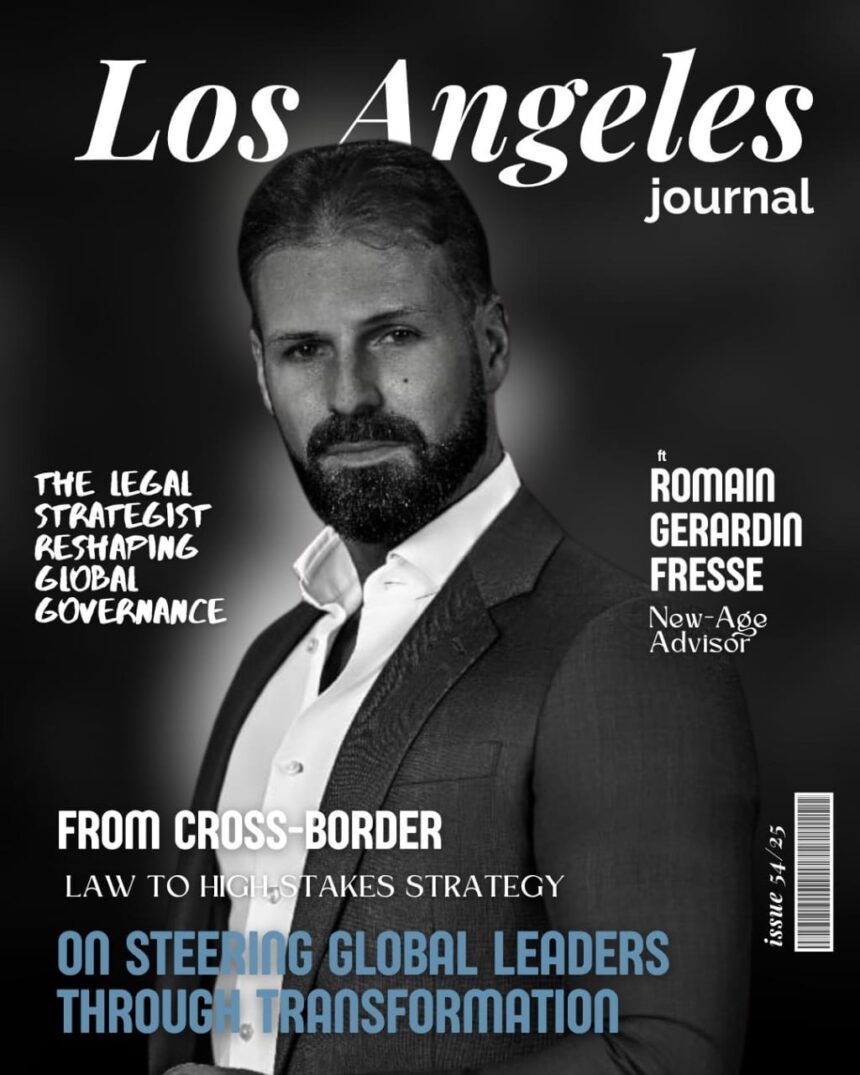
When Romain Gerardin-Fresse moved from Europe to the United Arab Emirates several years ago, he entered a region in the middle of an economic transformation. Dubai was accelerating its shift toward global investment, institutional development, and regulatory modernization. For a legal strategist trained in France’s public and corporate systems, it became an unusually productive vantage point.
Today, Gerardin-Fresse works between Dubai, Europe, Asia, and the United States, advising institutions and private groups on issues that often sit at the intersection of law, policy, and long-term strategy. His role is not always visible, but it places him close to complex negotiations, governance restructuring, and the design of systems meant to survive across jurisdictions.
“A lot of what I do is anticipation,” he says. “Understanding how rules interact, how pressures build, and how decisions made today will look five years from now.”
His clients come from sectors that include real estate development, hospitality, emerging technology, energy, and industrial expansion. Many operate across borders, where legal cultures collide and where the consequences of an error are amplified. For these groups, he is called less for crisis resolution than for preventing crises from emerging in the first place.
A senior executive at a European investment firm describes him as “someone who thinks structurally, not tactically – his concern is what holds the system together once all the noise is gone.”
Between Two Legal Worlds
One reason Gerardin-Fresse has found a place in the Gulf’s leadership circles is his familiarity with both civil-law and common-law environments. Europe, the Middle East, Asia, and North America operate under different legal assumptions, and many multinational structures fail because their governance models cannot absorb that tension.
“The challenge today is not only compliance,” he explains. “It’s coherence. When organizations expand without coherence, the cracks appear later, and they cost more to repair.”
Over the past decade, he has been involved in designing cross-border structures, mediating high-level shareholder disputes, advising on regulatory strategy, and supporting government-linked entities in institutional transitions. Those close to these projects say his influence is often felt in the architecture of a deal, even when his name does not appear publicly.
A Region in Movement
For observers of the Gulf, the timing of his rise is unsurprising. The UAE has positioned itself as a laboratory for legal modernization, economic diversification, and international engagement. Its leadership frequently invites outside expertise to support large-scale reforms.
“The UAE forces you to rethink what is possible,” he says. “There is a speed here that pushes you to refine your methods.”
This environment has also placed him in proximity to major transformation projects: restructuring of family-owned groups, new governance models for fast-growing companies, and negotiations involving investors from North America, Europe, and East Asia.
The Influence of Sports and Structure
Away from the professional sphere, Gerardin-Fresse is an active participant in the UAE’s equestrian and polo community. The sport, known for its tactical complexity, has influenced the way he approaches his work.
“Polo reminds you that every decision affects the next three,” he says. “It’s a good metaphor for strategy in general – you move based on what the field is becoming, not only what it is right now.”
While this aspect of his life may appear secondary, those who know him see continuity: the emphasis on movement, coordination, and reading the broader pattern rather than the immediate play.
A Broader Conversation About Leadership
In speaking with figures who have collaborated with him, a recurring theme appears: governance is becoming more demanding. Organizations once defined by geography now operate across cultures, legal systems, and economic models. In this environment, the traditional boundaries between legal work, strategic planning, and institutional design are eroding.
“People still talk about the future as if it’s a distant thing,” he says. “But the real difficulty is managing the present with enough discipline that the future doesn’t collapse under it.”
This perspective has positioned him not as a traditional lawyer, but as part of a new field emerging at the crossroads of law, policy, and institutional engineering.
Looking Forward
With activities now extending to Los Angeles, New York, London, Paris, Singapore, and Dubai, Gerardin-Fresse is increasingly involved in transcontinental advisory mandates involving regulatory transitions, multi-party negotiations, and the construction of governance for organizations scaling quickly.
For the Los Angeles business community – where entertainment, investment, and global partnerships often converge – profiles like his are becoming more relevant. Not because of publicity or showmanship, but because of the quiet demand for structure in a period defined by volatility.
“The question isn’t whether the world is changing,” he says. “It’s whether our institutions know how to stay upright while it does.”
In a landscape crowded with voices predicting the future, Gerardin-Fresse’s work focuses instead on something more fundamental: ensuring that when the future arrives, the architecture is ready to receive it.